Today we went to the wood and helped Butterfly Conservation in their survey of this year's migration of Painted Lady butterflies, which is the biggest for many years.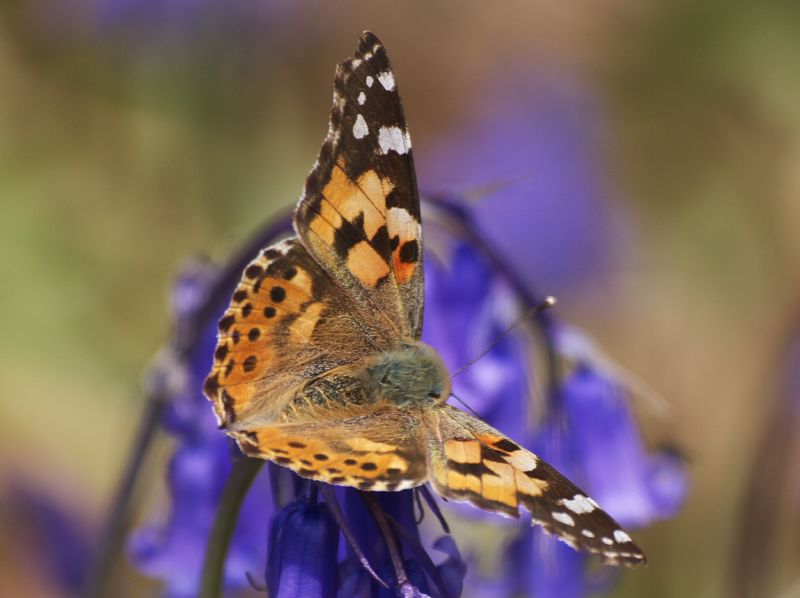


Saturday, 30 May 2009
A couple of hours in the sun


Friday, 29 May 2009
Ashden Awards Imperial College conference - 10 June 2009
There are still a few spaces available at this event (which I'm in charge of), so if you'd like to come, please send your name, organisation and email address to me at: conference@ashdenawards.org
Local solutions to climate change
The Ashden Awards Imperial College Conference
10 June 2009
The conference will bring the achievements of the 2009 International and UK Ashden Awards finalists to a specialist audience of practitioners, academics and students with a practical interest in sustainable energy. We will show short films about each finalist’s work, and then you will hear from them in person, talking about what has made their work so successful. With Q&As built into each session, and time during breaks to meet the finalists, there are ample opportunities to find out what you really want to know.
The Ashden Awards promote the widespread use of local, sustainable energy which can address climate change, alleviate poverty and improve quality of life. Find out more about us and our work at www.ashdenawards.org
We are delighted to be running this conference in partnership with Imperial College, London, and we are most grateful for significant support from the Faculty of Natural Sciences.
There is no charge for the conference or lunch, but numbers are limited, so please confirm names, positions and email addresses of people attending, by email to conference@ashdenawards.org. If you subsequently find that you are unable to attend, please let us know so that your place can be offered to someone else. The lunch provided will cater for vegetarians; if you have any other dietary requirements, please mention them when you confirm attendance.
Programme
09:30 Registration and refreshments
10:00 Welcome and introduction to the day
Professor Sir Brian Hoskins, Director of the Grantham Institute for Climate Change, Imperial College
10:10 Session 1: Buildings for the future
10:50 Session 2: Green energy businesses
12:15 Session 3: Mobilising communities
14:00 Session 4: Radical carbon cuts
15:30 Session 5: Scaling up
Thursday, 28 May 2009
A new badger sett
Tracy was up in the woods today with a friend, and in Sweep Wood they found what appears to be a new badger sett:
Mike

Monday, 25 May 2009
Nesting Great Tits, a singing Robin and a foraging Blackbird
The highlight of this weekend was on Saturday, when we found a family of Great Tits using the nesting box we'd put up in late February. The disappointment was going back on Sunday with the camera tripod to try and get some better pictures and finding that the youngsters had all left the nest! We weren't too surprised though, as looking back at the pictures it was clear that the chicks already had all their feathers - here's one poking his head out of the box:


While I was waiting to get video of the Great Tits, I also got a little bit of a blackbird foraging:
These weren't the only birds in the wood though. Our little friendly Robin (we call him Rob, predictably) was guarding our camp as usual:

Last but not least, we saw where a woodpecker has been working at a dead branch in an oak near the entrance to our wood (this is why dead wood up a tree is important!):
Mike


Woodgas camp stove demo
You may have noticed in some recent posts that we've got a fancy new stove to use at the wood - well, here's a demo video of how it works. (Still pictures and a text explanation are below)
It's a WoodGas CampStove XL. What it does is "gasify" the wood, burning the gas produced in an efficient manner right under the cooking pot. Basically there's a cylinder inside it that you fill with small sticks:
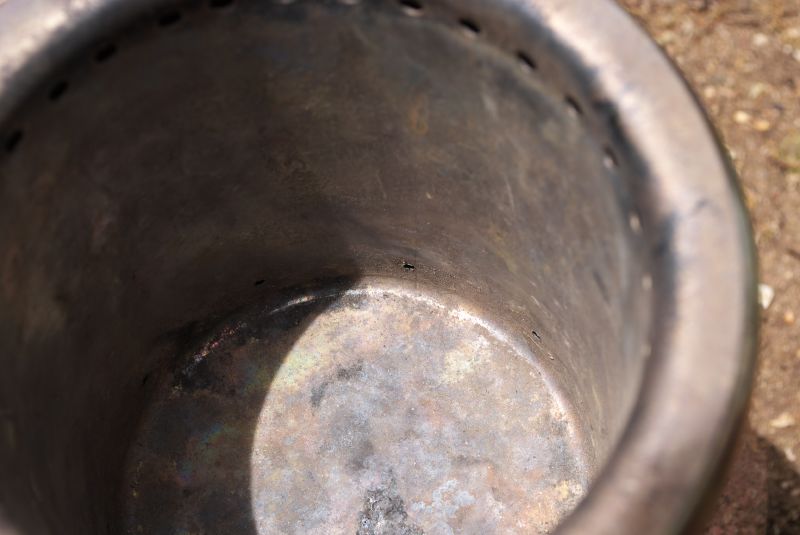 If you look carefully you'll see some small holes at the base of this cylinder - these allow in a small amount of air to gasify the wood. Gasification means allowing the wood to partially burn, resulting in a mixture of gases, including hydrogen, methane and carbon monoxide (so don't use it indoors). These are all flammable gases, and as they rise up the inside of the stove they meet with more air injected through a ring of holes at the top of it:
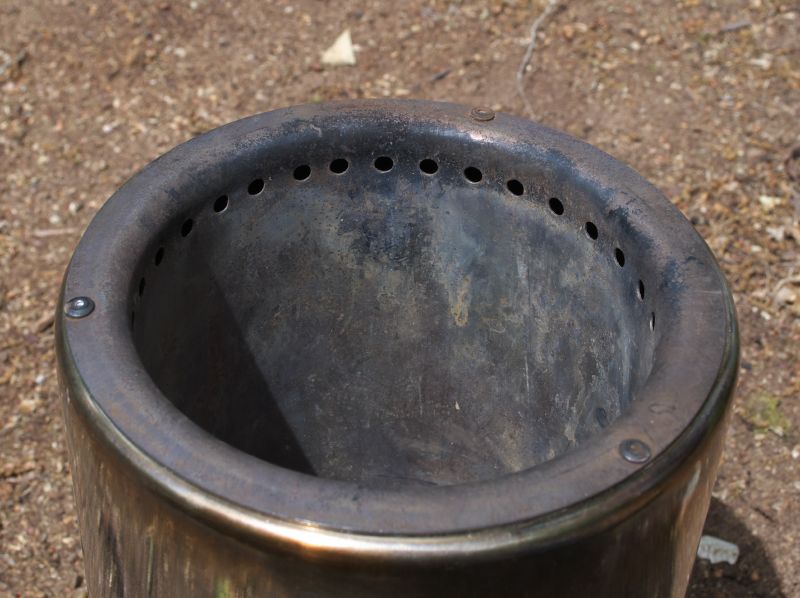 The gas mixes with this additional air and burns. Right above it sits your cooking pot, resting on a simple but effective pot stand:
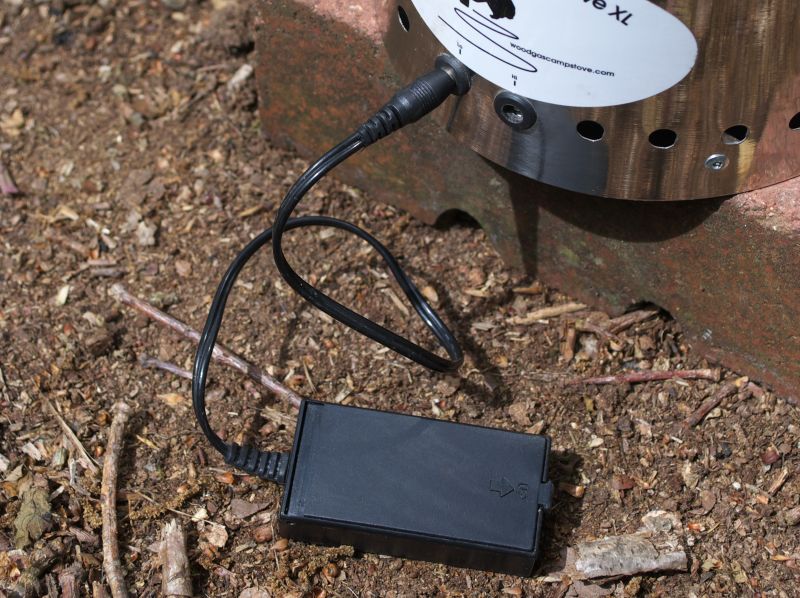
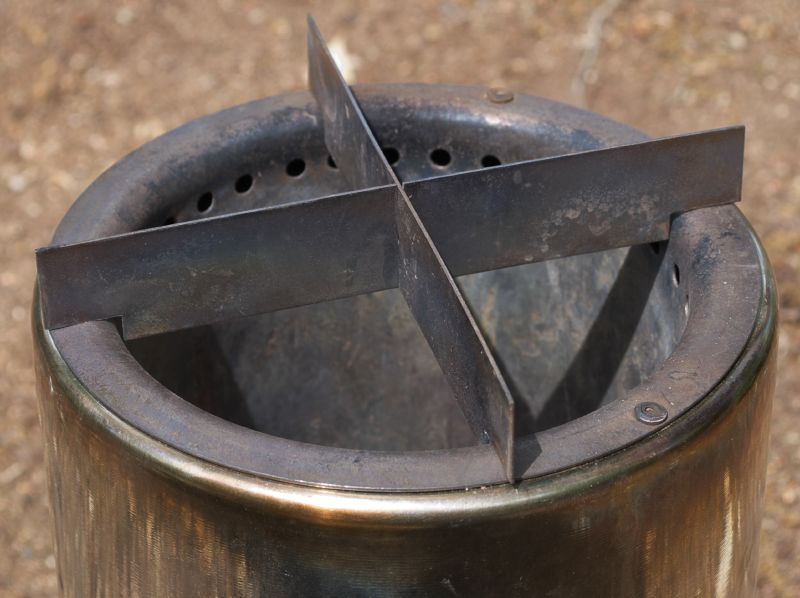 The air is drawn in through holes around the the outside of the base of the stove, which encloses a small fan. In the picture below you can see the two power sockets for the fan (high and low speed), and the air inlet holes:
 The battery pack contains two AA rechargeable batteries (I reckon my 3200mAh batteries will run it for over 15 hours), and you plug it into the high or low speed socket depending on how much heat you want out of the stove:
Mike
Click here to read the rest of this post.


