Just a short video I happened to see today:
Showing posts with label peak oil. Show all posts
Showing posts with label peak oil. Show all posts
Tuesday, 13 April 2010
Unsustainable 2010: the video


Thursday, 25 March 2010
UK government holds summit on Peak Oil
As announced in The Guardian on Sunday, the UK government recently held a summit on Peak Oil:
Lord Hunt, the energy minister, is to meet industrialists in London tomorrow in a bid to calm mounting fears about the disruption that could follow a sudden shortage of oil supplies.The event was held behind closed doors, but fortunately one of the participants, Rob Hopkins from Transition Towns, has published a write-up, respecting the Chatham House Rule under which the summit was held. Here's a little bit of it:
In a significant policy shift, the government has agreed to undertake more work on whether the UK needs to take action to avoid the massive dislocation that could be caused by the early onset of "peak oil" – the point that marks the start of terminal decline in global oil production.
Jeremy Leggett, the executive chairman of the renewable power company Solar Century and a leading figure in the UK industry taskforce on peak oil and energy security, said the meeting, to be held at the Energy Institute, showed a welcome new sense of urgency. "Government has gone from the BP position – '40 years of supply left, the price mechanism works, no need to worry' – to 'crikey'," he said.
...it was fascinating and frustrating in equal measure. Fascinating that it represented the first time the UK government has created a space to explore the peak oil question, what the Guardian that morning called a “significant policy shift”, how it overlaps with climate change and what policies they might make in response. Fascinating that Transition Network is seen as worthy of an invitation to such an event, that our work is recognised at that level.
Frustrating in that every time the question of economic growth and whether or not the idea had any mileage in a world of depleting energy reserves was raised it was largely glossed over. Frustrating in that so often the question of what we might to do in response to peak oil focused almost purely in transportation and on the timely and complete creation of an electric car fleet, with a recharging network and sufficient electricity to keep the whole thing going, with no consideration as to how a nation which is the second most indebted in the world, which has become a net energy importer at a time of increasing price volatility and little remaining indigenous energy, is actually going to pay for such an infrastructure. Frustrating because the techno-fix mindset was prevalent, and the idea that part of a response might include the intentional refocusing of the scale of economic activity, the application of the Proximity Principle to economics didn’t really register with people.
Anyway, who knows, perhaps nothing will come of it, but it certainly felt like a pretty historic occasion to me, and although it was only attended by a small number of people, I hope that this garbled account offers some sense of what went on behind the closed doors of the Energy Institute.
You can read the full report from Rob here.
Mike
Click here to read the rest of this post.
Monday, 22 March 2010
Tipping point - will Peak Oil crash our civilisation?
The following is the summary from a recent report from Feasta.
Click here to read the rest of this post.The credit crisis exemplifies society's difficulties in the timely management of risks outside our experience or immediate concerns, even when such risks are well signposted. We have passed or are close to passing the peak of global oil production. Our civilisation is structurally unstable to an energy withdrawal. There is a high probability that our integrated and globalised civilisation is on the cusp of a fast and near-term collapse.
As individuals, and as a social species we put up huge psychological defences to protect the status quo. We've heard this doom prophesied for decades, all is still well! What about technology? Rising energy prices will bring more oil! We need a Green New Deal! We still have time! We're busy with a financial crisis! This is depressing! If this were important, everybody would be talking about it! Yet the evidence for such a scenario is as close to cast iron as any upon which policy is built: Oil production must peak; there is a growing probability that it has or will soon peak; energy flows and a functioning economy are by necessity highly correlated; our basic local needs have become dependent upon a hyper-complex, integrated, tightly-coupled global fabric of exchange; our primary infrastructure is dependent upon the operation of this fabric and global economies of scale; credit is the integral part of the fabric of our monetary, economic and trade systems; a credit market must collapse in a contracting economy, and so on.
We are living within dynamic processes. It matters little what technologies are in the pipeline, the potential of wind power in some choice location, or that the European Commission has a target; if a severe economic and structural collapse occurs before their enactment, then they may never be enacted.
Our primary question is what happens if there is a net decrease in energy flow through our civilisation? For it is absolutely dependent upon increasing flows of concentrated energy to evolve and grow, and to form and maintain its complex structures. The rules governing energy and its transformation, the laws of thermodynamics, are the inviolate framework through which all things happen- the evolution of the universe, the direction of time, life on earth, human development, the evolution of civilisation, and economic processes. This point is not rhetorical, access to increasing flows of concentrated energy, which can be transformed into work and dispersed energy, is the foundation upon which our civilisation stands. Yet we are at a point where these flows are, with high probability, about to begin decreasing. We should intuit that an energy withdrawal should have major systemic implications, for without energy flows nothing happens.
The key to understanding the implications of peak oil is to see it not just directly through its effect on transport, petrochemicals, or food say, but its systemic effects. A globalising, integrated and co-dependant economy has evolved with particular dynamics and embedded structures that have made our basic welfare dependent upon delocalised 'local' economies. It has locked us into hyper- complex economic and social processes that are increasing our vulnerability, but which we are unable to alter without risking a collapse in those same welfare supporting structures. And without increasing energy flows, those embedded structures, which include our expectations, institutions and infrastructure that evolved and adapted in the expectation of further economic growth cannot be maintained.
In order to address these questions, the following paper considers the nature and evolution of this complex integrated globalised civilisation from which energy is being withdrawn. Some broad issues in thermodynamics, the energy-economy relationship, peak oil, and the limits of mitigation are reviewed. It is argued that assumptions about future oil production as held by some peak oil aware commentators are misleading. We draw on some concepts in systems dynamics and critical transitions to frame our discussion.
The economics of peak oil are explicated using three indicative models: linear decline; oscillating decline; and systemic collapse. While these models are not to be considered as mutually exclusive, a case is made that our civilisation is close to a critical transition, or collapse. A series of integrated collapse mechanisms are described and are argued to be necessary. The principle driving mechanisms are re-enforcing (positive) feedbacks:
- A decline in energy flows will reduce global economic production; reduced global production will undermine our ability to produce, trade, and use energy; which will further decrease economic production.
- Credit forms the basis of our monetary system, and is the unifying embedded structure of the global economy. In a growing economy debt and interest can be repaid, in a declining economy not even the principal can be paid back. In other words, reduced energy flows cannot maintain the economic production to service debt. Real debt outstanding in the world is not repayable, new credit will almost vanish.
- Our localized needs and welfare have become ever-more dependent upon hyper- integrated globalised supply-chains. One pillar of their system-wide functioning is monetary confidence and bank intermediation. Money in our economies is backed by debt and holds no intrinsic value; deflation and hyper-inflation risks will make monetary stability impossible to maintain. In addition, the banking system as a whole must become insolvent as their assets (loans) cannot be realised, they are also at risk from failing infrastructure.
- A failure of this pillar will collapse world trade. Our 'local' globalised economies will fracture for there is virtually nothing produced in developed countries that can be considered truly indigenous. The more complex the systems and inputs we rely upon, the more globalised they are, and the more we are at risk from a complete systemic collapse.
- Another pillar is the operation of critical infrastructure (IT-telecoms/ electricity generation/ financial system/ transport/ water & sewage) which has become increasingly co-dependent where a systemic failure in one may cause cascading failure in the others. This infrastructure depends upon continual re-supply; embodies short lifetime components; complex highly resource intensive and specialized supply-chains; and large economies of scale. They also depend upon the operation of the monetary and financial system. These dependencies are likely to induce rapid growth in the risk of systemic failure.
- The high dependence of food on fossil fuel inputs, the delocalisation of food sourcing, and lean just-in-time inventories could lead to quickly evolving food insecurity risks even in the most developed countries. At issue is not just food production, but the ability to link surpluses to deficits, collapsed purchasing power, and the ability to monetize transactions.
- Peak oil is likely to force peak energy in general. The ability to bring on new energy production and maintain existing energy infrastructure is likely to be severely compromised. We may see massive demand and supply collapses with limited ability to re-boot.
- The above mechanisms are non-linear, mutually re-enforcing, and not exclusive.
- We argue that one of the principle initial drivers of the collapse process will be growing visible action about peak oil. It is expected that investors will attempt to extract themselves from 'virtual assets' such as bond, equities, and cash and convert them into 'real' assets before the system collapses. But the nominal value of virtual assets vastly exceeds the real assets likely to be available. Confirmation of the peak oil idea (by official action), fear, and market decline will drive a positive feedback in financial markets.
- We outline the implications for climate change. A major collapse in greenhouse gas is expected, though may be impossible to quantitatively model. This may reduce the risks of severe climate change impacts. However the relative inability to cope with the impacts of climate change will be much greater as we will be much poorer with much reduced resilience.
This will evolve as a systemic crisis; as the integrated infrastructure of our civilisation breaks down. It will give rise to a multi-front predicament that will swamp governments' ability to manage. It is likely to lead to widespread disorientation, anxiety, severe welfare risks, and possible social breakdown. The report argues that a managed 'de-growth' is impossible.
We are at the cusp of rapid and severely disruptive changes. From now on the risk of entering a collapse must be considered significant and rising. The challenge is not about how we introduce energy infrastructure to maintain the viability of the systems we depend upon, rather it is how we deal with the consequences of not having the energy and other resources to maintain those same systems. Appeals towards localism, transition initiatives, organic food and renewable energy production, however laudable and necessary, are totally out of scale to what is approaching.
There is no solution, though there are some paths that are better and wiser than others. This is a societal issue, there is no 'other' to blame, but the responsibility belongs to us all. What we require is rapid emergency planning coupled with a plan for longer-term adaptation.
Tuesday, 10 November 2009
IEA whistle-blower spills the beans on Peak Oil
The world is much closer to running out of oil than official estimates admit, according to a whistleblower at the International Energy Agency who claims it has been deliberately underplaying a looming shortage for fear of triggering panic buying.Read the full story in the Guardian
The senior official claims the US has played an influential role in encouraging the watchdog to underplay the rate of decline from existing oil fields while overplaying the chances of finding new reserves.
...
In particular they question the prediction in the last World Economic Outlook, believed to be repeated again this year, that oil production can be raised from its current level of 83m barrels a day to 105m barrels. External critics have frequently argued that this cannot be substantiated by firm evidence and say the world has already passed its peak in oil production.
Now the "peak oil" theory is gaining support at the heart of the global energy establishment. "The IEA in 2005 was predicting oil supplies could rise as high as 120m barrels a day by 2030 although it was forced to reduce this gradually to 116m and then 105m last year," said the IEA source, who was unwilling to be identified for fear of reprisals inside the industry. "The 120m figure always was nonsense but even today's number is much higher than can be justified and the IEA knows this.
"Many inside the organisation believe that maintaining oil supplies at even 90m to 95m barrels a day would be impossible but there are fears that panic could spread on the financial markets if the figures were brought down further. And the Americans fear the end of oil supremacy because it would threaten their power over access to oil resources," he added.
A second senior IEA source, who has now left but was also unwilling to give his name, said a key rule at the organisation was that it was "imperative not to anger the Americans" but the fact was that there was not as much oil in the world as had been admitted. "We have [already] entered the 'peak oil' zone. I think that the situation is really bad," he added.
Also reported in the Telegraph... Click here to read the rest of this post.
Thursday, 30 October 2008
The Oil Crunch: Securing the UK’s energy future
Well, here's something you wouldn't have expected to see a year ago....
The subtitle is: "First report of the UK Industry Taskforce on Peak Oil & Energy Security (ITPOES)"
and the members of this group are: Arup, FirstGroup, Foster and Partners, Scottish and Southern Energy, Solarcentury, Stagecoach Group, Virgin Group, Yahoo!
You can download it here.
Mike
Friday, 8 August 2008
Supply gap could mean oil hits $200 a barrel
Just in case you thought the recent fall in the oil price was a new trend....
Only a collapse in the global demand for oil can save economies from a supply crisis and crude prices reaching more than $200 a barrel, according to a report out today.
Energy expert Paul Stevens says that governments and companies are investing too little to meet future needs and a "supply crunch" will hit within "five to 10 years."
His report, for the Chatham House think tank, dispels hopes that the recent 20pc fall in the oil price from its $147.27 peak might herald a return to more manageable levels. "A spike of over $200 is possible," Mr Stevens concludes.
(Full article in the Telegraph)
Check out these sites for more info:
http://www.powerswitch.org.uk/
http://www.theoildrum.com/
Mike Click here to read the rest of this post.
Wednesday, 14 May 2008
Ancient woodland vs oil supply
I guess with oil hitting record high prices every week (it's up 100% on a year ago), and existing fields declining fast people are getting desperate. I'm not surprised they're drilling there if they think there's oil to be had, but it's a shame to damage the woodland. You'd think with today's drilling technology they could go in at an angle from the side and not touch the woodland...Oil company to drill in ancient Sussex woodland
Conservationists reacted angrily today to Sussex county council's decision to grant an oil company permission to prospect in a protected area of the Douth Downs.Northern Petroleum was granted a temporary three-year consent to test in Markswell Wood in the village of Forestdale, near Chichester. Council officers said that there was a "clear and overriding need" for oil exploration but that the company would have to seek further permission to extract oil.
For the background on why oil is so expensive right now, visit PowerSwitch UK (a group I helped start a few years ago).
Mike Click here to read the rest of this post.
Thursday, 8 May 2008
Oil price up over 100% in last year
May 7th 2007 - oil closed at $61.47
May 7th 2008 - oil closed at $123.53
That's an increase of almost 101%.
In sterling, the price a year ago was £30.86, yesterday it was £62.63, a rise of almost 103%.
Expect to see rising petrol and diesel prices continue indefinitely...
If you've not heard of peak oil before, visit PowerSwitch UK
Mike
Monday, 21 April 2008
Progress on the shed, and another oil record
Another day, another oil price record ($117.76 peak, $117.48 settle) - at least that's what seems to be happening this April. BBC reporting on it here. Why? Because we've on the plateau, production can't go higher, but demand is there. Just think how much fuel's going to cost when we hit the decline!
Anyway, that's what's going on the big wide world. In our little world in Rye, the shed is making progress, as part of our preparations for a post-peak-oil world...
We went down early evening, before dinner, and set about fitting the roof. this thrush was very interested, and watched us from a nearby shed, singing his little heart out. Tracy was able to get very close for a picture - I guess the birds are quite tame around the allotment, bring used to seeing people working

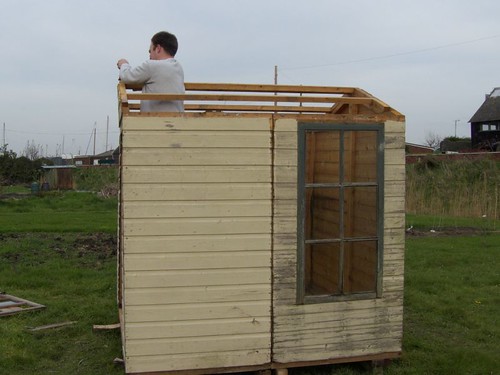
As the shed is old and somewhat warped, and rotten in places, things didn't quite fit together like new, and a little trimming was required...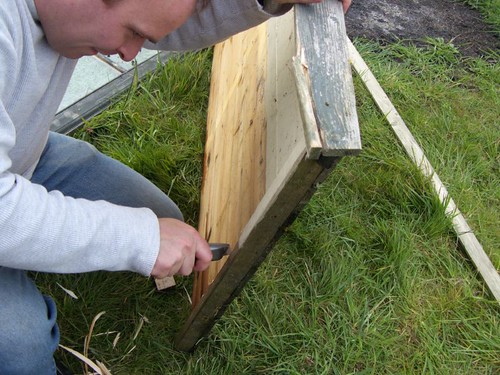 But before too long it was coming together: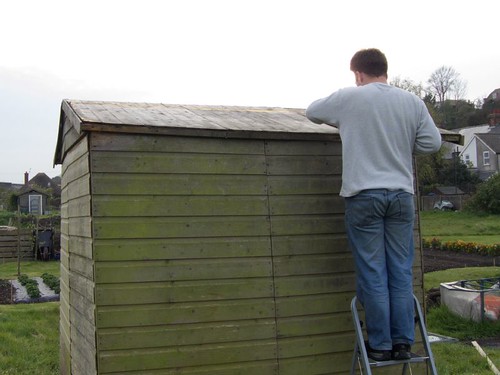
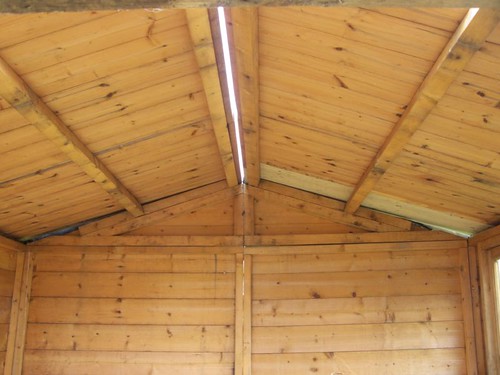 The next step is to put the felt onto the roof, which will cover the gap you can see in the above picture.
We're hoping to get the shed finished in the evenings this week, so on Saturday we can get up to the wood and make some more progress on brash burning, log stacking and making piles of dead wood to leave for wildlife.
Mike
Oil and refineries
In case you missed it in the news, Grangemouth refinery in Scotland is in the process of shutting down in preparation for a 2-day strike by its workers over pensions. They have to shut the whole plant down because it would be unsafe to leave it running with no operators, and it takes a week to close. I guess it will probably take a week or more to restart as well.
The workers seem to have a legitimate case, and the company, Ineos, is making a big fuss, warning about how fuel supplies will run out in Scotland and Northern England. They are being accused of scaremongering.
Of course this is one of those self-fulfilling prophecies, as as soon as shortages are seen to be a risk, anyone with any sense will realise that although there wouldn't be a problem if nobody panicked, the fact is that some people will, therefore it is in your own best interests to stock up with fuel. I know I would (well, in fact I already have, though hopefully the shortages won't make it as far as Rye...).
It'll be interesting to see how it all turns out, I can imagine some frenetic activity between the company, the union and the government in the next few days!
The main thing I hope for is that it will continue to draw attention to the problem of Peak Oil, especially if we get some real shortages. The fact that the refinery normally processes 200,000 barrels of crude oil a day from the North Sea is already having an impact on oil prices, which hit a new record this morning of $117.40. Many people reckon it will hit $120 within a week or two. Expect some higher petrol and diesel prices on the way....
Here's some links:
The news on the refinery
The topic being discussed on The Oil Drum
Mike
Saturday, 1 March 2008
Oil hits inflation-adjusted record high
From Reuters:
U.S. oil surged to a new inflation-adjusted record high on Thursday, surpassing the previous record of $102.53 set in 1980, according to the International Energy Agency.Full story here
and the reason behind it all (and why we own a wood!).
Mike Click here to read the rest of this post.
Thursday, 31 January 2008
Einstein and Peak Oil
I like this: If anyone's wondering, the equation ER/EI is "energy return" divided by "energy invested" (more info here), the point being that the oil (and coal and gas) we extracted in the past was easy to get at, so the energy return was large compared to the energy invested.
Today, the EROEI (as it's more commonly known) ratio is a lot lower, as we go for difficult-to-get fossil fuels, such as polar oil and tar sands, and is falling as each year goes by. That means that there's less energy for the human race to live on, just as demand is rising. I expect you don't need me to tell you that means trouble...
So now you know one of the incentives for us buying a wood - it grows renewable fuel for us!
So what's the EROEI for a chainsaw? Well, we've only burned about 12 litres of petrol so far, which might move a small car 120 miles or so, and contains in the region of 500MJ of energy. That fuel has enabled us to cut 10 tonnes of wood (at a conservative guess, it could be a lot more), which once seasoned could yield about 150,000MJ of energy. I think that's a better return than burning it in a car! I think I'll go and burn some more tomorrow...
Mike
p.s. More info on Peak Oil is available at PowerSwitch UK, which I helped set up a few years ago. Other good sites are The Oil Drum and EnergyBulletin.
Subscribe to:
Posts (Atom)


