I was off work yesterday, and Tracy didn't need to work all day, so in the afternoon we headed up to the wood, and decided to make a start on the improved shelter we've been planning for some time. The shelter's needed to store our tools for woodland management and a few other odds and ends that need to be kept dry - the current shelter isn't great, as when the tarpaulin's down it gets condensation underneath, and stuff gets wrecked.
The first step was to mortise some holes in the logs for the base. This is done using the chainsaw to bore holes, as shown below. You must be careful when doing this, as there is a risk of kickback, and I wouldn't recommend anyone to do it without proper training. The basic idea is that you start the cut with the underside of the nose of the bar (which won't cause kickback):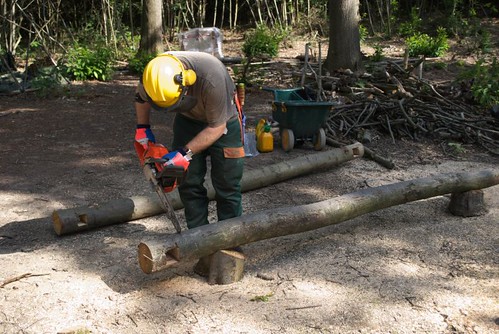 and push in, cutting a slot:
 Once the slot is formed you can rotate the saw to the vertical without the risk of kickback because it is contained by the slot:
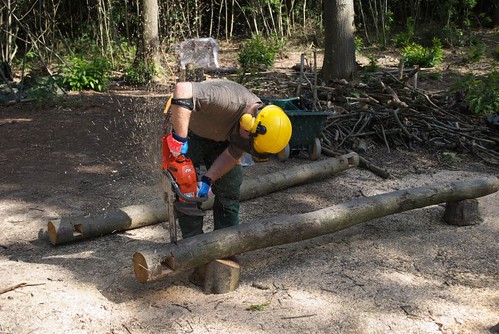 then you just let the weight of the saw take it through the wood:
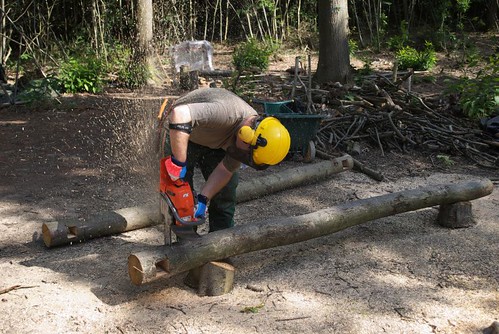 do this three more times: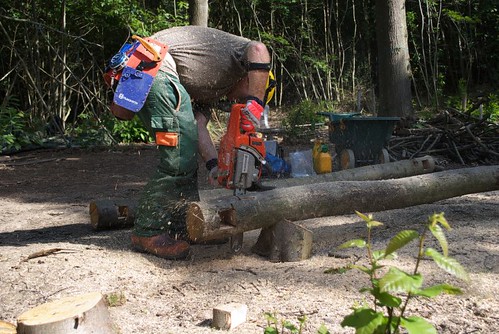
 and then you can pop out the block you've cut, leaving a square hole behind:
 Tracy cleared an area while I carried the logs down:
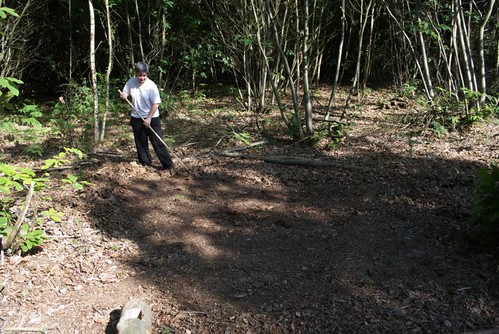 and laid them out in the rough shape we want:
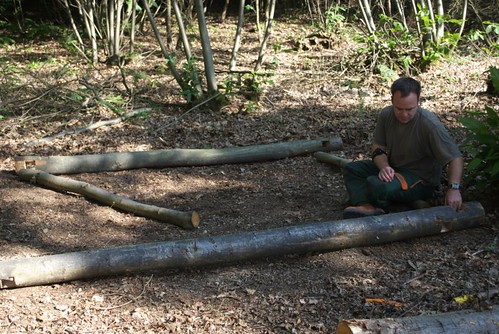 The smaller poles to fit into the mortises needed trimming down a bit:
 We used a draw knife initially for this:
 but found that some needed quite a bit cut off, so used the chainsaw - not as neat, but about 100 times quicker, literally! No photos of that though, as Tracy was holding the logs while I cut them.
Here it is all fitted together: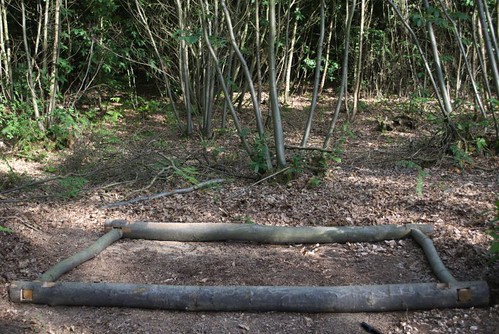
 The next job is to put bolts through each corner to secure the poles, and then start making the roof section in a similar way.
After the jobs we wandered off to the pond. From what we've been told the egg we found is probably from a wood pigeon, as it's white and would have been about 4cm long when intact. Also, we know there are wood pigeons around, so that makes it more likely.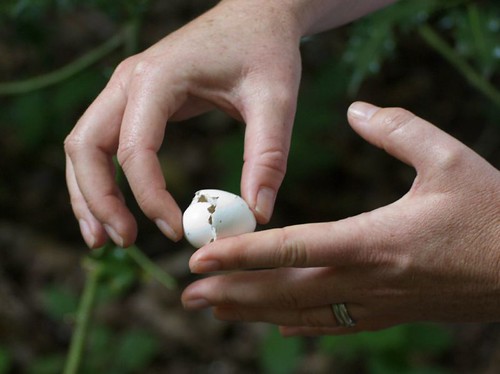 I'm taking a few pictures of how the rides look, so we can compare next summer after we've coppiced the edges of them:
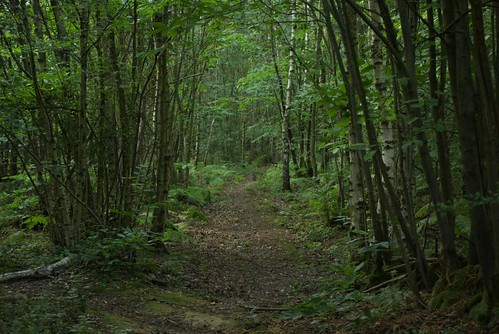 At present there's a massive transition from dark to light when you come into the area we've coppiced:
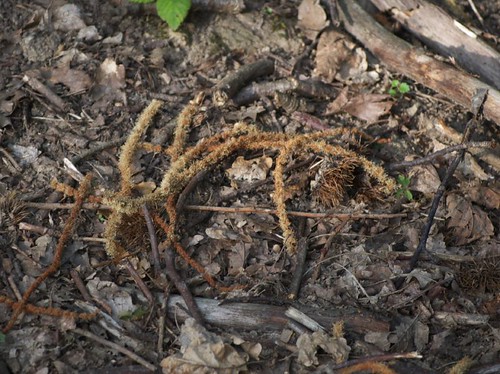
 There's something new on the ground - the flowers from the chestnut trees. Hopefully this means there'll be some chestnuts to eat this autumn, and also an end to hayfever!
 Just before we left, our attention was caught by a tapping noise high up in the trees. After standing and watching for a bit we spotted the source - a nuthatch! It was hard to get good photos as it was a long way up, so I've had to crop these down a lot, but they're the best ones we've got so far of one, and in it's natural habitat too: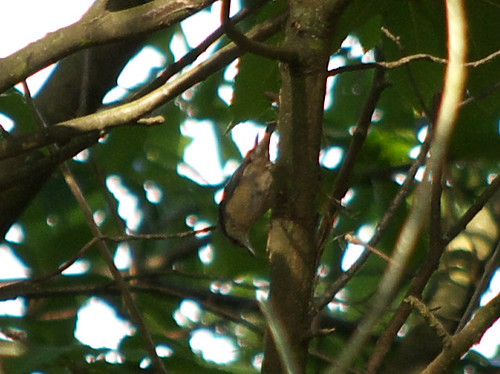
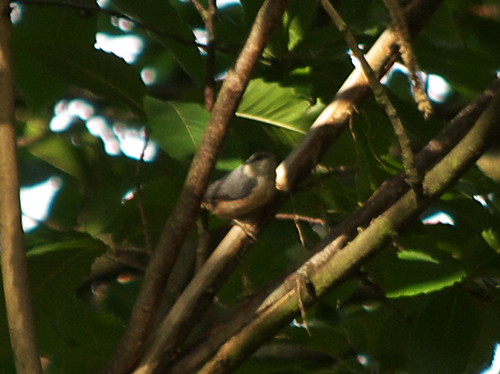
 The nuthatch was searching for things to eat in the chestnut, which was interesting as I'd assumed the oak would have been a better food source. Perhaps there's something crawling up and down the trunks...
Finally, here's a patch of the flattened area in the wayleave where we're trying to keep the bracken down to create a parking and timber storage area. We tried raking back the bracken debris, figuring that it would be preventing other plants getting started. Sure enough, here's the patch a week or so later, with grass sprouting: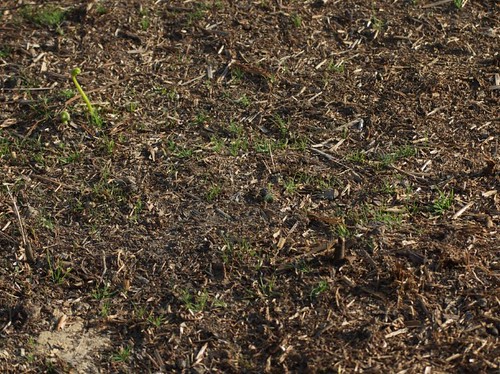 That's all for now, we're going up again this evening to try and see the badgers! Also, Steve from Butterfly Conservation is coming to run a moth trap session in the wayleave, to survey what's there, so we'll be letting him in and seeing how it works.
Mike
UPDATE: links to posts on building the shelter:
http://peplers.blogspot.com/2008/07/more-shelter-building.html
http://peplers.blogspot.com/2008/07/shelter-frame-finished.html
http://peplers.blogspot.com/2008/07/shelter-complete.html
Monday, 21 July 2008
Shelter building and a nuthatch


A busy weekend
Wow, that was hectic! After Alex visiting on Friday, we went to the SWOG meeting Tracy had organised on Saturday, and then on Sunday tried out some electric bikes in London and carried on up to Oxford to catch up with various friends and visit our old church in the evening.
The SWOG event was very worthwhile, and Tracy will be posting a summary on the SWOG website later. For now though, here's a quick summary:
Nigel Symes, RSPB Woodland Advisor and author, told us about the disturbing loss of species of birds known as "woodland specialists" - i.e. they only live in woodland. These included the Lesser Spotted Woodpecker, Marsh Tit, Hawfinch, Redstart, Willow Warbler, Woodcock, Lesser Redpoll, Willow Tit and Tree Pipit. These species have all declined significantly, some drastically, since about the late 80s or early 90s. As far as the RSPB can tell, the main reason for their decline is the progressive cessation of woodland management since the 1940s, with a time delay before the effects became apparent.
The RSBP recommended strategy to help these birds includes:
David Plummer, wildlife photographer, gave an excellent talk on badgers. He's been watching them in his wood for some time now, and has had guests to watch them too. He illustrated his talk with excellent pictures, all taken by himself. The interesting thing when it comes to watching badgers is that they have very poor eyesight, but excellent smell, so as long as you sit downwind you can get really close! To find out more about David's badgers, and also his photography training courses, visit his blog and photogrpahy website.
Alan Sage, woodland manager and craftsman, spent the afternoon explaining the practicalities of managing woodlands, covering far more than I can write about here, and answering questions from anyone who asked. He's worked in coppicing and other forestry activities for many years, and specialises in using his craft skills to produce valuable products from the wood he manages. His key message was that it is possible for any woodland owner to make some money from the produce of their wood, and that this money would enable them to manage the wood better for biodiversity and enjoyment. A great many woods are neglected because the owners do not have the time to manage them, or the money to pay someone else to, and the biodiversity suffers as a result. Therefore, helping people get woodland products to market can be a big help, as well as displacing unsustainable materials such as metal, plastic concrete, brick and fossil fuels. To find out more about the training courses and other services offered by Alan, visit http://www.ajscrafts.co.uk
OK, so that was quite a detailed summary!
We went up to the wood today (Monday) to do various things, and I have some pictures, but I'll have to wait until tomorrow to post them...
Bye for now, Mike
Friday, 18 July 2008
Badgers and firewood
I had my friend Alex visiting today. We cycled down to the beach in the morning, and then took lunch up to the wood, where I sawed up a couple of birch logs and then Alex tried out the maul - I think he'll be buying one!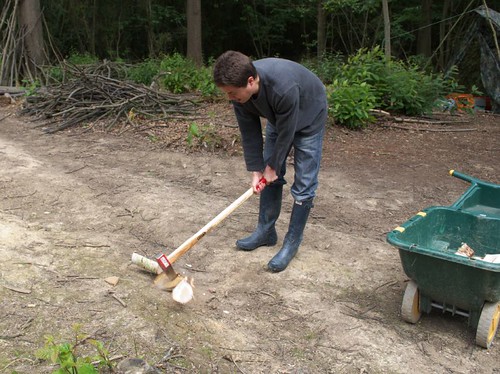 We filled the wheelbarrow and then emptied it into Alex's car - he'll be burning it this winter (the wood, not the car). Then we went off on a walk around the woods to look at the wildlife...
Plenty of butterflies in the wayleave, even though it was cloudy. I got a picture of this Small White (I think): Over in Sweep Wood we saw an old badger sett: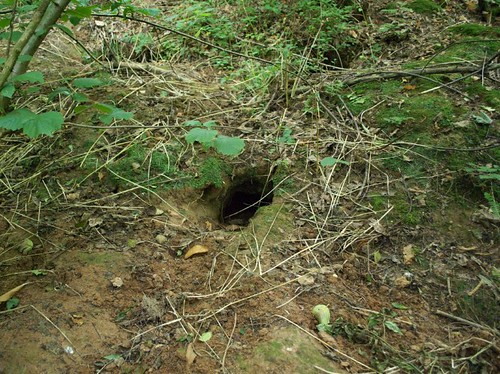
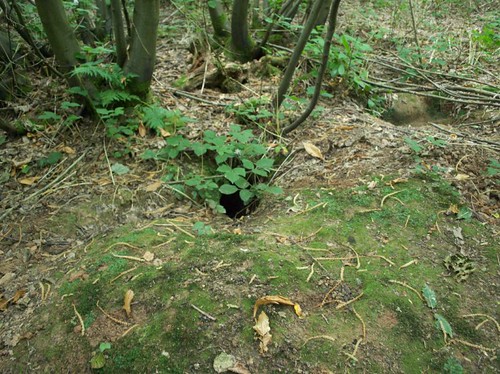 but what caught my attention was the new digging, it looks the badgers have moved back in: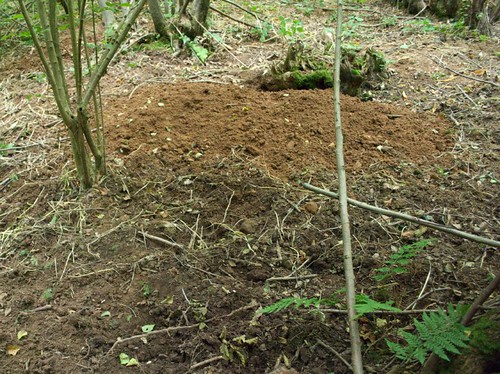

 They weren't the only things digging - there were moles too (apologies for the flash photo):
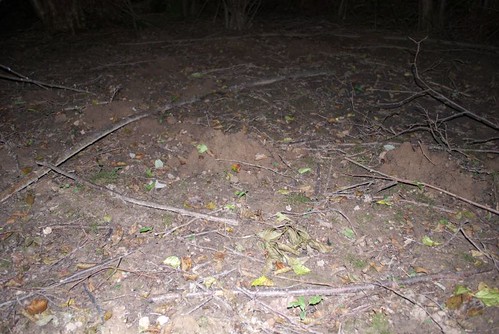 It might be interesting to go out and spy on the badgers one evening...
We're not at the wood tomorrow - out all day at the SWOG meeting.
Mike
Sunday, 13 July 2008
Management planning and a fox.
We had a meeting today in the woods. Steve Wheatley came to advise us and some of the other woodland owners on management of the woods for biodiversity. Steve's particular focus is on butterflies, but he knows about other wildlife too, as he's trained in conservation, ecology and other useful things! We had people from Grist Wood and Fantail Wood, and we were representing my parents as well as our own wood.
Steve gave us lots of useful advice on designing a management plan that will work for parts of the wood and the wood as a whole - we have some work to do now...
One thing that's clear now is our plan for this winter's work - we'll be coppicing a few metres at the edge of the rides and footpaths that run along and through our wood, creating "scalloped" areas at intervals as mini-clearings and to break up any wind-tunnel effect. We'll also be avoiding damage to the occasional interesting trees along the way, such as a few youngish oaks (very pleased to see these!), hornbeam and holly - simply because they're different to everything else growing there, so add to the diversity. We may also find a few chestnut stems we can leave to grow on as standards, maybe increasing their nut production...
After everyone had gone, I wandered off on my own with the camera. The wood is still full of birds and stuff, you just can't see them as easily because of the leaves. I managed to get a couple of shots of a blue tit though:
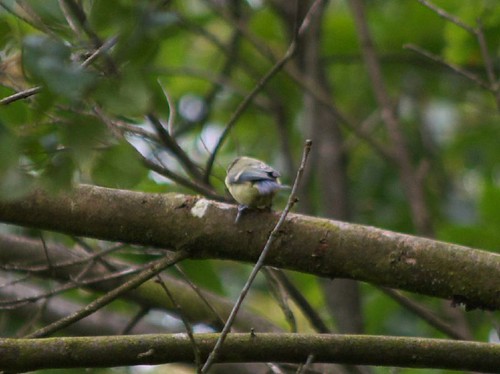 I saw a coal tit too, plenty of different butterflies and a huge dragonfly, though it wouldn't sit still for a picture! It's amazing how much you see when you stop and stand still for a few minutes...
Most exciting though was getting to the style from the wayleave onto the public footpath and seeing a fox! It was nearly 100 metres away and about to disappear round the bend in the path, so I didn't have time to get a good photo as I had the camera set up for the sunny wayleave, not the shady wood, but here's a blurry cropped image of the fox: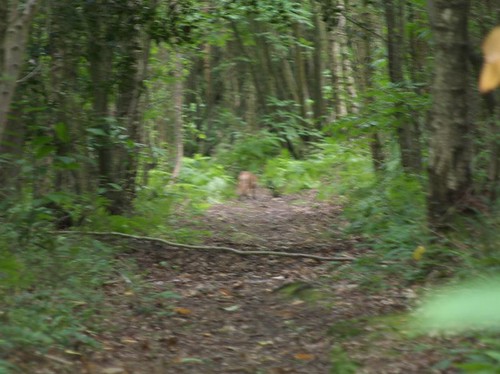 We thought they were in the wood, but this is the first one we've seen. Cool!
Anyway, got to go, there's a lot to do, as we've just rented a garage out the back of our flats (sharing with a neighbour), so there's stuff to be sorted and moved...
Mike
Friday, 11 July 2008
Tracy's first go on the chainsaw!
Today was the day Tracy got to try out all her new chainsaw gear!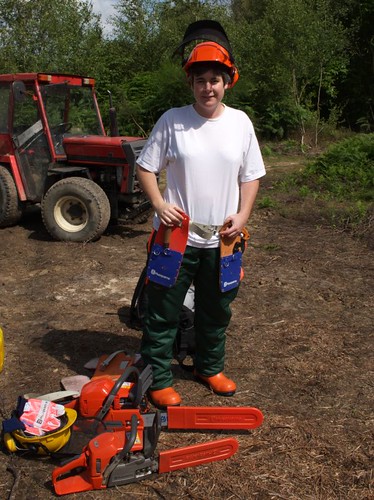
I'd given her a bit of a safety briefing at home, and she did very well, starting the saw safely and doing a bit of logging. The main idea was for her to get a feel for it prior to doing the training in a couple of weeks, so she'll only be doing simple stuff until then.
When looking for something to practice on, we remembered this tree, which I think must have been damaged during the oak felling and ended up hung up in an oak, with the stool lifting up. Time to take it down to give it a chance to sort itself out, and also a chance for me to try out the new Husqvarna 570 we bought on Monday.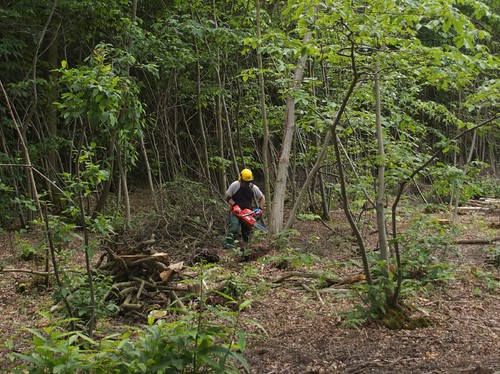
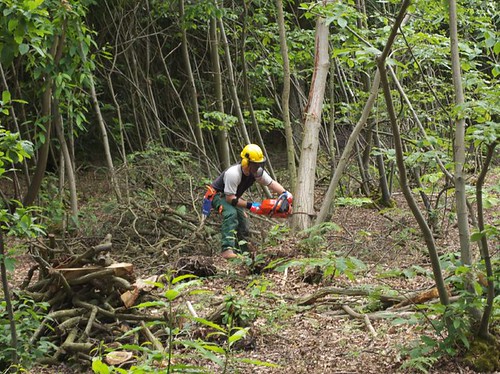 It's a great saw! The 346XP we have is good, but this is bigger and more powerful. It even has two exhaust vents! ;-) Here I am doing a bit of snedding with it. It goes through the wood like a hot knife though butter, and sounds good at the same time:
Here's Tracy doing some logging with the 570, though she used the 346 the rest of the time:
Before long it was all tidied up: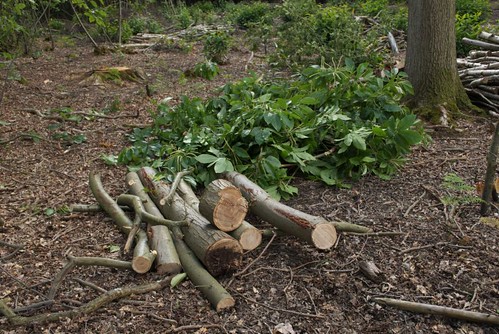 With the growing tips down where we could see them we got a good picture of the chestnut flowers:
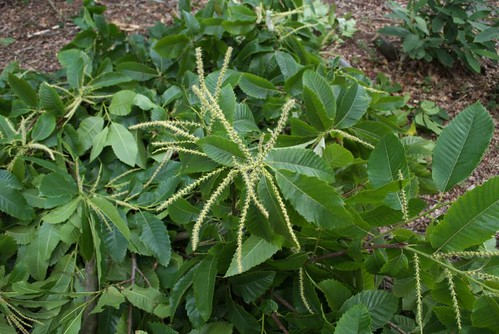 They have quite a distinctive smell up close! (and give Tracy hayfever for a couple of weeks each year...)
We did some other stuff too. including tidying up some of the produce so it's in a fit state for customers. Here's a new log pile, with some long straight poles behind that I'm keeping for myself: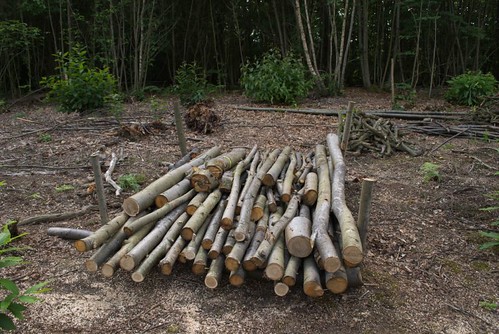 Tracy also discovered the difference a sharp chain makes to a saw, comparing the brand new 570 to the 346 with a fairly blunt chain. I was put to work sharpening it:
 Tracy had a go too though, and she'll have do do the whole maintenance thing on her course in August!
We took a quick walk over to the pond, and found this under the oak tree: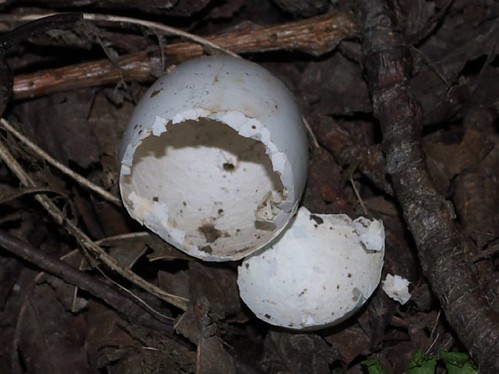
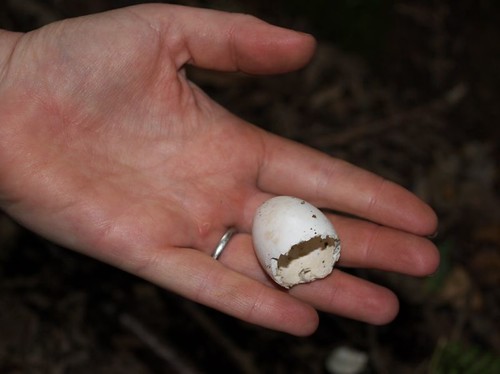 Any ideas on what bird hatched from it? We've not found a good egg ID website yet...
There was also evidence of rabbits or deer on the ride to the pond. This birch stool had been growing like crazy a few weeks ago, but isn't looking so great now: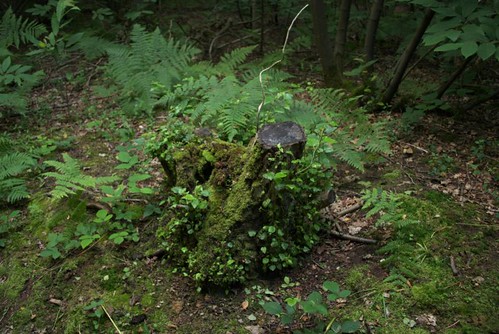
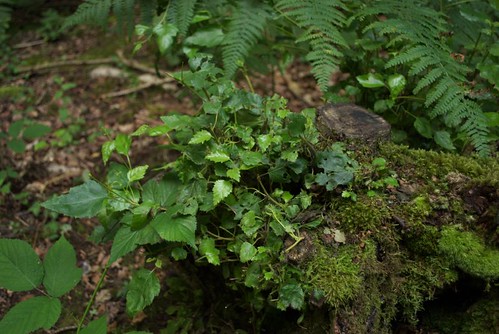 Still, while they're eating that they're not eating the chestnut or oak! Suppose they have to eat something anyhow, and it's nice to have them around.
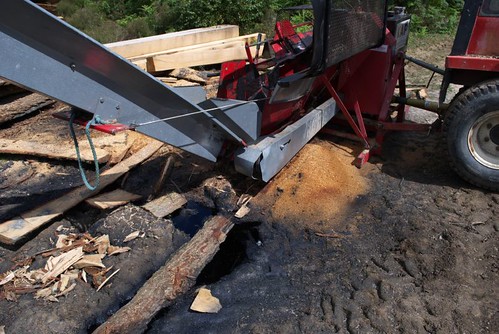
The last thing of interest was Tim's logging machine. He'd left it coupled up to a small tractor, which had been powering it: Judging form the pile of sawdust under it, it had seen some use! By the way, the black stuff here and in past pictures from sawmilling is not oil or anything else nasty. It's caused by tannins coming out of the oak sawdust.
 Mike
Mike


