We're on a coppice harvesting course all week, here's today's update. The course is run by David Rossney of Esus Forestry.
We started by choosing between two areas that both need coppicing, and having picked one David used a spray can to mark out lines through the coppice that we would work along. The idea is to leave clear paths that a vehicle with a mechanical grab can drive down, with stacks of 16-foot logs along the sides for it to collect.
Once the three of us (me, Tracy and Paul) were spread out with our own patches to work in, we got started by "breaking in" - felling small trees to create a clearing to fell larger trees into, and have a fire in. To maximise efficiency the small stuff was all cleared first, cutting it into lengths for the fire, then moving on to felling the larger trees. The aim was to fell trees so that the top was near the fire, ready to burn the brash, and the bottom was near the edge of the strip we were working, ready to add to a log pile.
After creating a clearing it was possible to set up a "bench" across the strip: The bench is held by a sling at one end:
 The purpose of the bench is that you can fell trees onto it, so that they're at a comfortable height for snedding (removing branches) and cutting the logs to length. Once you've cut one 16-foot length off and snedded the part near the fire, you can drag the tree back over the bench to do the next log, and also the next bit of snedding. This way all the brash ends up next to the fire, and all the logs in one place. Here's Tracy's spot:
 Once an area is cleared, you move the bench and the fire along ready to do the next bit. The logs are stacked at the edges, and the grab will be able to reach the end piles without even going into the wood:
 as it goes along the main ride:
 In between the hard work we've time for drinks and a chat too:
 We'll be back to it again tomorrow, starting in the wood at 8:30am and finishing about 5pm.
Mike
If you missed the other posts, Day 2 is here, Day 3 is here, Day 4 is here, Day 5 is here.
Monday, 13 October 2008
Coppice Harvesting course - Day 1


Sunday, 12 October 2008
BBC Countryfile magazine
Yesterday we were interviewed by Miriam O'Reilly for the BBC Countryfile magazine, as they're doing an article on people buying woodland and working it. It all went well, she asked lots of good questions and we look forward to seeing the article. A photographer, Adrian Arbib, came with her, and he stopped for a while afterwards to chat with us as he was particularly interested in what we were doing. We had a good chat about the current events in energy and finance, and why owning a wood was a good idea because of them.
I didn't take many photos as we were busy, but here's a great one of a spider web with dew on it first thing: After they'd gone we did a bit of work, mainly splitting some of the birch we'd already felled and stacking it to dry. I did the big bits with the maul (splitting axe), while Tracy did some smaller bits with the froe and mallet.
 We sharpened our chainsaws too (always much nicer to do this outdoors), as we're going on a coppice harvesting course all this week, to learn some new techniques. I hope to do a few posts covering what we're learned. We're doing the course with David Rossney of Esus Forestry, who trained us both in chainsaw use and tree felling.
Mike
Thursday, 9 October 2008
Coppicing this week
We had Monday and Thursday working in the wood this week, again focusing on the footpath. Here's an example of the progress we've made, with a picture from the start of the week:  and at the end of today:
 Here's the view from inside, before:
 and after, with much more light coming in.
 With the birch already felled and logged, it's been pretty easy where I've been working to get some chestnut down. I cleared a section near the stile:

 and was then able to set up some racks to store the chestnut logs:
 After today these are now filling up, with large non-straight logs for fuel, and small straighter logs for other uses, such as stakes and garden furniture:
 There's a third pile too, of all the smaller twisty bits and offcuts, probably just for us to use in the wood for cooking on, or anything else that comes to mind. If they don't get use they can just rot (slowly, being chestnut) and provide food for fungi and beetles.
 Tracy's also been busy, working further along the path. You can see a pool of light in the distance, looking from where I've been working:
 She's been felling birch so far at that end, and has a few nice piles of logs building up, and more light coming down to the ground.

 Once we get along to this point with the chestnut we should be able to make fast progress, as with the birch out of the way they won't get hung up very often.
One highlight of the day was a cooked lunch, consisting of chilli con carne reheated in our adapted fondue burner:
 and rice cooked on a wood fire in the cast iron BBQ:
 Tracy took a quick trip to the pond at the end of the day. The plant growing in it is continuing to spread:
 but a new one (which we will try and ID) has joined it:
 Our next trip to the wood is on Saturday, as we have a journalist and photographer from BBC Countryfile magazine coming to visit us. Apparently they're doing an article on why people are buying woodland.... we'll be sure to give them some interesting answers ;-)
Mike
Sunday, 5 October 2008
Fungi ID walk in the woods
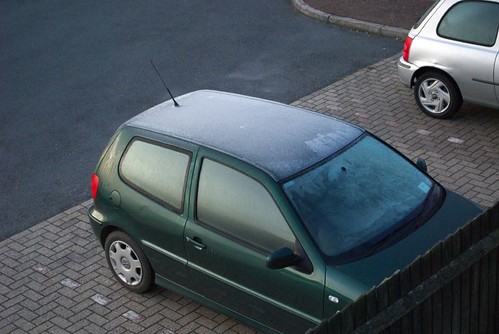
On Saturday we had a fungi ID walk in our woods. It was run by WoodNet, and should have happened at Flimwell, but the woods there didn't have much fungi right now, so we offered ours instead. We had a good crowd of people: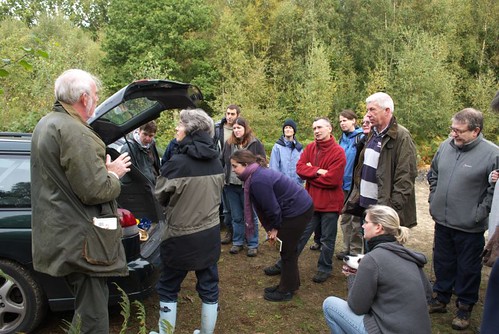 The day started with the first frost of the winter though, which isn't so good for the fungi. We had to scrape a bit of ice off the car in the morning:
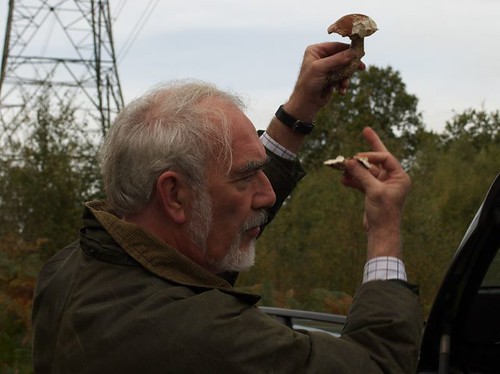
 To start with the course tutor, Bryan Bullen, gave us a talk on fungi, explaining some of the different families and how to recognise them, using samples he'd brought with him:
 Then we headed off down the wayleave, which is damp and mossy and therefore ideal fungi ground.
 We spread out a bit looking for specimens, bringing them to Bryan (or Bryan to them) for ID.
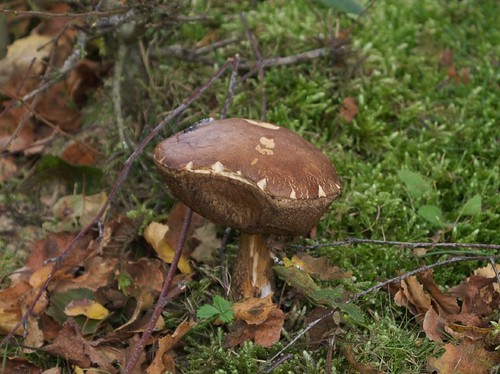
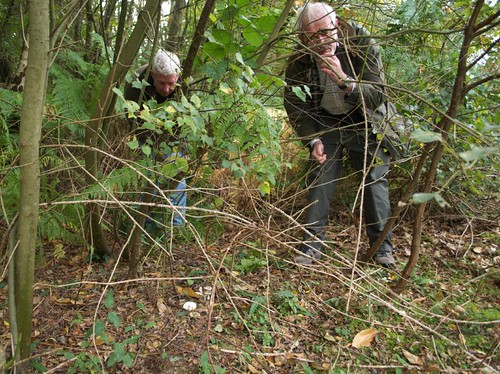 One we found quite a bit of was the Brown Birch Bolete, which is edible, although best when younger than these samples:
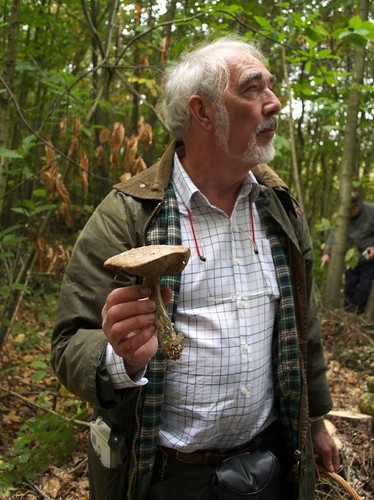 We also saw a few stinkhorns, here's the "egg" of one that was yet to grow, with Bryan indicating the height it would normally reach.
 He cut it open so we could see the jelly-like substance inside. It didn't smell yet though, as it wasn't mature.
 Then we headed through the woods, spreading out to gather fungi and meeting up to ID them. We felt we found quite a good selection, but Bryan said this isn't a very good year for them so far, although better than last year. Here's what we got between us:

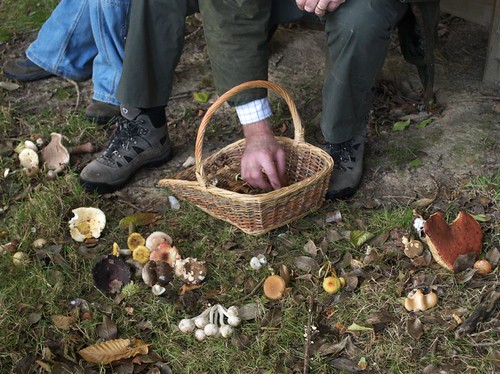 A few of them were edible, but we also "tasted" some inedible (though not poisonous) ones, being careful to spit them out afterwards. Some of them are extremely hot, tasting like chilli! It had never occurred to me that you could safely taste mushrooms (and I mean a very tiny amount on your tongue!), but apparently it's one of the aids to making an accurate identification. Bryan recommended we didn't try it with known killers like the Death Cap though, even though it should still be safe.
Mike
Coppicing while the sun shines
We spent Thursday and a short time at the end of Friday coppicing, taking advantage of the sunshine while we had it. We're still just felling the birch, leaving the chestnut until the leaves are off it, as that should mean it is drier to start with, and also the regrowth will be straighter. We've now got lots of little piles of logs along the path: We were hoping to go up this afternoon and split them, but the weather is wet and very windy...
Tracy's been getting in some practice before we go on a coppice harvesting course next week, felling a larger birch here:


Many of the trees get hung up along the path, but the birch are easy to roll/slide out safely using a cant hook and long felling lever. Once they're all out of the way there'll be more space to fell the chestnut. Here's Tracy's tree on the ground.
 The path is now getting noticeably lighter:

 One of the trees I felled had an old bird nest in it, which I saved to get a photo of. We're not sure what bird used it, but we *thought* a dropping in it was from a green woodpecker. Any ideas?
 This is of course one of the reasons why we're coppicing now, and not in the spring - we knew this bird nest would not be occupied at this time of year.
We had a great lunch up there on the Thursday - a stew using some of our own vegetables from the allotment and meat from a rabbit I shot a couple of weeks ago. Cooked over a wood fire of course, so another nice low-carbon meal :-)

 I did some chainsaw sharpening as well - much nicer to do it outdoors in the sunshine than at the kitchen table in the evening.
 And finally, autumn is definitely here:
 Mike
Click here to read the rest of this post.


